Vandero Insect EliminationVandero Insect Elimination

Attic Roof Rat Exclusion Houston

Roof rats exploit structural vulnerabilities created by Houston's dense coastal foliage and intense Gulf storms. The species runs power lines, tree canopies, and tall landscaping directly onto asphalt shingle roofs. In…
Get My Free Estimate →(346) 776-1709
Attic Roof Rat Exclusion in Houston, TX
Quick answer
  • Scope: Comprehensive 32-point exterior inspection, sealing of all penetrations larger than 0.5 inches with 19-gauge hardware mesh and structural flashing, multi-day interior attic trapping, and pheromone decontamination.
  • Turnaround time: Exterior mechanical exclusion is completed in 1 to 2 days, followed by 5 to 10 days of targeted interior trapping and daily monitor checks.
  • Cost structure: Baseline on-site diagnostic inspections start at $150, with complete structural exclusion and extraction running from $650 to $2,800 depending on home footprint and roofline architecture.
  • Pests targeted: Invasive black roof rats (Rattus rattus), Norway rats, and native tree squirrels chewing into attic spaces.
  • Scheduling contact: Confirmed on-site dispatch across Harris County via dispatch at (346) 776-1709 or text a photo of the exterior breach line for preliminary review.

Roof rats exploit structural vulnerabilities created by Houston's dense coastal foliage and intense Gulf storms. The species runs power lines, tree canopies, and tall landscaping directly onto asphalt shingle roofs. In older homes across The Heights, Montrose, and West University Place, roof rats consistently gain entry through rotted fascia boards, unmeshed soffit vents, and exposed ridge-vent junctions. Modern builds and expansive estates in Memorial, River Oaks, and Kingwood see identical attic penetrations around HVAC chase lines, copper refrigerant pipe gaps, and zero-clearance chimney trim. A mature roof rat squeezes through an opening just 0.5 inches wide, which matches the diameter of a standard US nickel. Trapping alone fails when structural entries remain open, because foreign rats follow pheromone trails straight back into the soffits within 48 to 72 hours of an open trap sequence.

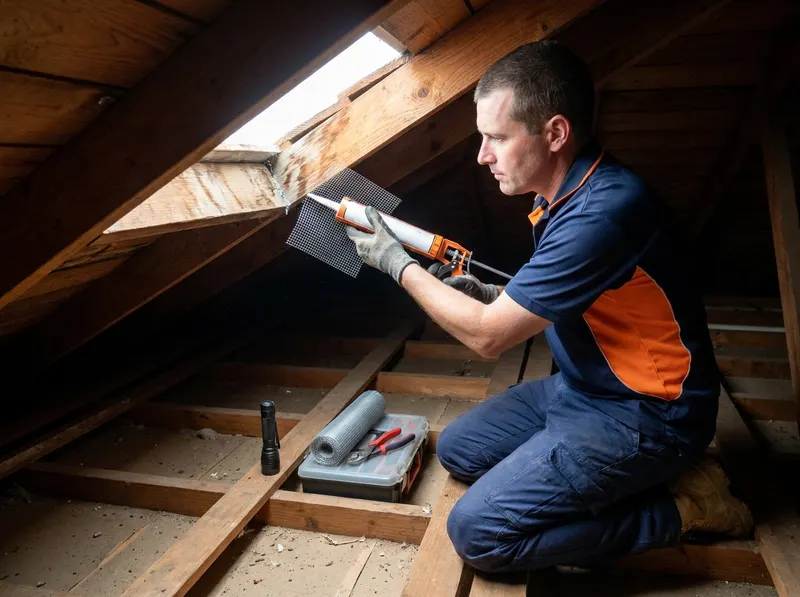
Effective exclusion requires a clinical, multi-stage barrier method rather than temporary expanding foam, which rodents chew through in under 20 minutes. Exterior mechanical sealing uses heavy galvanized steel wire cloth, concrete patches, and metal flashing to secure dormers, gable vents, plumbing stacks, and roof-to-fascia gaps along every square foot of the roofline. In high-humidity bayou zones near Clear Lake City, Meyerland, and Oak Forest, storm water runoff softens wood decking, allowing roof rats to rapidly enlarge minor gaps. Once all secondary access pathways are secured, one-way exit tunnels or specialized lethal snap-trap grids inside the attic drop the remaining population to zero inside 7 to 10 days. The mechanical intervention eliminates recurring toxic rodenticides from attic voids, preventing secondary poison hazards to pets and eliminating foul carcass decomposition behind bedroom drywall.

Deciding between routine trap-only maintenance and complete structural exclusion comes down to property permanency. Routine baiting traps individual adult rats but leaves open structural highways for new colonies every autumn and spring; exclusion eliminates the entry point permanently, requiring a higher initial material investment. The process follows four concrete steps:

1. Complete attic footprint mapping to identify electrical wiring gnaw marks, duct run tears, and primary grease rub marks (sebum trails).

2. Elevation inspections across the full exterior perimeter using 24-foot extension ladders to locate every gap exceeding 0.5 inches.

3. High-grade hardware fastening: riveting 19-gauge, hot-dipped galvanized mesh and sheet metal over vulnerable timber joints, AC chases, and roof returns.

4. Interior suppression and attic sanitation: deploying monitored lethal mechanical stations in attic runs, vacuuming droppings with true HEPA equipment, and treating insulation with an enzymatic odor neutralizer.

Attic Roof Rat Exclusion cost in Houston

Comprehensive Diagnostic Roof & Attic Inspection$150, $250 (credited toward total exclusion)
Targeted Entry Point Sealing (1-3 Minor Gaps)$350, $650
Complete Structural Exclusion (Homes up to 2,500 sq ft)$850, $1,800
Extensive Estate Exclusion (3,000+ sq ft / Complex Multi-Pitch Roofs)$1,850, $3,200
Full Attic Decontamination & Pheromone Neutralization$500, $1,600

Every job gets a firm, written price after a free on-site visit.

Common questions

Why do roof rats invade attics in Houston during winter and summer?
Houston roof rats seek climate-controlled attic insulation to escape high subtropical humidity, severe downpours, and mid-summer attic temperatures exceeding 130 degrees Fahrenheit, moving from live oaks and palms directly into roof intersections.
How does professional attic roof rat exclusion differ from store-bought foam and poison blocks in Houston?
Store-bought expanding spray foam contains polyurethane that rodents chew through in minutes, and poison blocks cause rodents to die inside inaccessible wall voids; professional exclusion uses 19-gauge galvanized hardware cloth and structural metal flashing that teeth cannot penetrate.
What is the typical time required to complete full roof rat exclusion on a Houston home?
Exterior sealing of vents, eaves, and penetrations takes 1 to 2 business days, followed by 5 to 10 days of targeted interior trapping to verify zero remaining activity in the attic space.
Can roof rats in Houston attics cause structural fire hazards?
Roof rats possess continuously growing incisors requiring constant gnawing, and they routinely strip the PVC insulation from 120-volt non-metallic Romex electrical wiring, creating direct arc-fault and attic fire hazards.
How do tree branches impact attic rat exclusion warranties across Houston neighborhoods?
Tree limbs hanging within 6 feet of the roofline serve as continuous highway bridges for rodents; property managers must cut canopy limbs back at least 8 feet from gutters to protect the exclusion warranty and prevent rats from jumping over roof flashings.
Helpful resources

Trusted references & local links

USA.gov, government & consumer helpBetter Business BureauFTC Consumer AdviceU.S. Small Business AdministrationReady.govU.S. EPAENERGY STARU.S. Dept. of EnergyConsumer.govU.S. Census BureauGoogle Maps, Houston, TX

Get started today

Tell us about your attic roof rat exclusion job in Houston and we'll send a clear, written quote, usually the same day.

Get your free pest control services quote, Houston

We only use your ZIP to check availability, no spam.