Subterranean termite pressure in Southeast Texas remains among the highest in North America due to hyper-humid Gulf Coast conditions, dense alluvial soil, and extended warm seasons that accelerate reproductive…
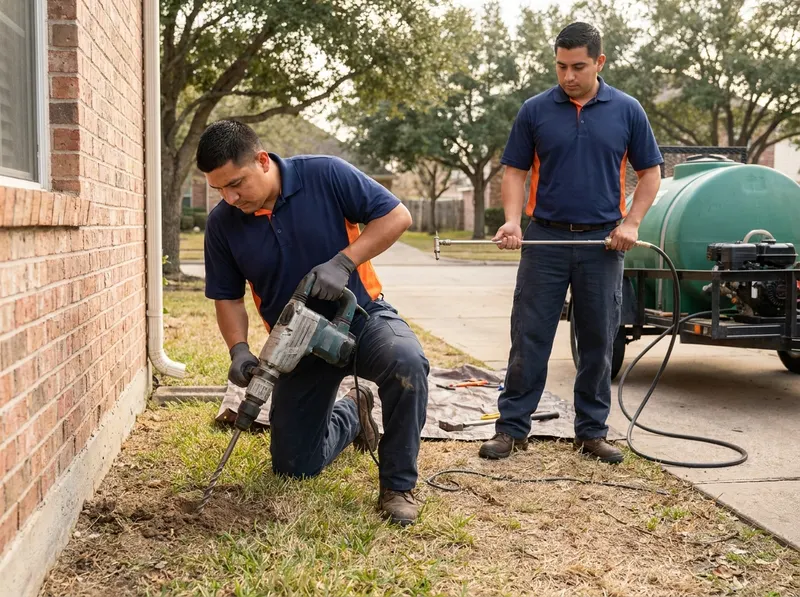
Subterranean termite pressure in Southeast Texas remains among the highest in North America due to hyper-humid Gulf Coast conditions, dense alluvial soil, and extended warm seasons that accelerate reproductive swarming. Pier-and-beam bungalows in The Heights and Montrose often experience direct mud tube construction along brick piers, while monolithic slab foundations in Memorial, River Oaks, and West University Place frequently suffer hidden entry through expansion joints, bath traps, and plumbing penetrations. Native eastern subterranean colonies build ground-based networks beneath structural perimeters, whereas Formosan colonies in Kingwood and Clear Lake City create secondary aerial carton nests inside wall voids when condensation from plumbing or roof leaks provides sustained moisture.
Executing decisive elimination requires matching the chemistry to the structural construction rather than applying generic over-the-counter surface sprays that merely repel workers to adjacent framing studs. Liquid non-repellent termiticide barriers bind directly to the soil clay particles around the foundation footer at an application rate of 4 gallons per 10 linear feet per foot of depth, per EPA label standards. Worker termites pass through the undetectable compound without alarm, mechanically transferring the active ingredient throughout the gallery network to collapse the central queen. In properties bordering high water tables or dense bayou root systems in Meyerland and Oak Forest, perimeter bait stations spaced 10 to 15 feet apart offer an effective alternative, utilizing chitin synthesis inhibitors that halt the molting cycle across entire foraging zones without saturating water-adjacent soils.
Selecting between a continuous perimeter soil barrier and a bait matrix system depends on foundation type, drainage clearance, and whether Formosan cartons exist within the superstructure. Continuous liquid barriers provide immediate containment on standard monolithic slabs by killing termites as they tunnel through treated soil zones, but they require continuous drilling through attached concrete patios, driveways, and tile walkways. Baiting systems eliminate drilling through architectural masonry and protect sensitive landscape beds, but colony eradication takes 60 to 90 days as insect growth regulators slowly circulate. Structural eradication protocols deploy odor-free, non-volatile compounds that bind tightly to substrate particles, avoiding lingering indoor vapors or airborne dispersion into living spaces. Every deployment focuses strictly on total colony termination without locking property managers or homeowners into unnecessary, open-ended subscription packages.
Every job gets a firm, written price after a free on-site visit.
Tell us about your subterranean termite treatment job in Houston and we'll send a clear, written quote, usually the same day.
 Vandero Insect Elimination